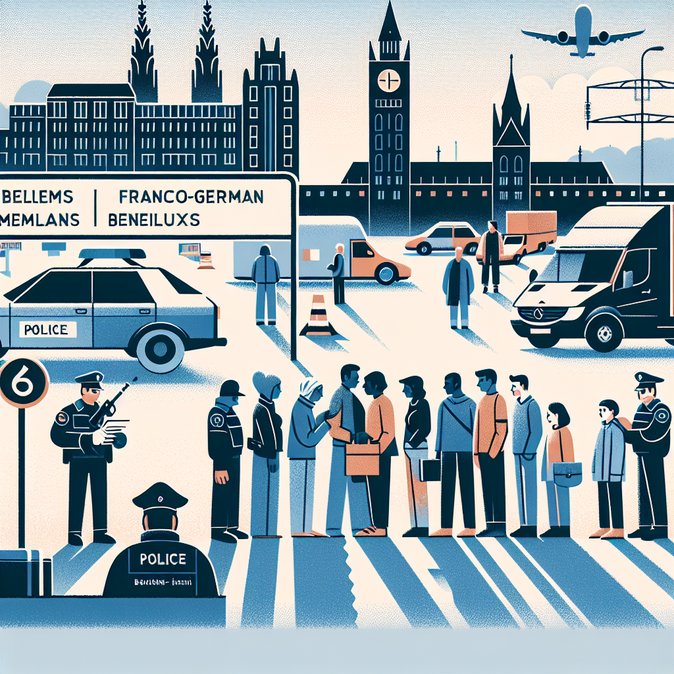
Germany’s re-imposed Schengen-area border controls have passed a new milestone. Figures released on 15 December by the Federal Police for the western states of Rhineland-Palatinate and Saarland show 5,515 irregular entries detected between 16 September 2024 (the day controls were re-introduced) and 30 November 2025. Most crossings originated in France (3,454), followed by Luxembourg (1,730) and Belgium (331). The interior ministry has already notified Brussels that the controls—originally justified by high asylum numbers and smuggling rings—will remain in force until at least mid-March 2026.
Why it matters for global mobility: The figures underline how Germany’s “temporary” internal border regime is becoming semi-permanent. Although inspections remain largely risk-based, business travellers and cross-border commuters now encounter random checks on routes that were previously friction-free, including the busy A64 motorway into Luxembourg, a corridor used daily by more than 50,000 German workers. Logistics operators are also reporting longer dwell times for trucks headed to the Port of Antwerp via Belgium.
Legal context and criticism: Under Schengen rules, internal checks must be a measure of last resort and strictly time-limited. Critics—from the Luxembourg government to German state premiers—argue that stationary checkpoints violate both the letter and the spirit of Schengen. Berlin counters that the extension is proportionate, pointing to 2,547 “push-backs” to France, 1,134 to Luxembourg and 197 to Belgium, plus 169 suspected smugglers arrested and 669 fugitives captured since September 2024.
![Germany Logs 5,500 Irregular Entries as Extended Border Checks Shift Schengen Travel Calculus]()
Practical implications:
• HR managers should advise frequent travellers to carry either a passport or national ID, even on same-day trips.
• Expect occasional queues at border crossings near Trier (A64), Saarbrücken (A6) and Aachen (A4).
• Companies running just-in-time supply chains through Belgium or northern France should build a buffer of 30-60 minutes for potential inspections.
• Employees of Luxembourg-based financial institutions may need written proof of employment to avoid secondary questioning.
For organisations and individuals that need additional support, VisaHQ can streamline the documentation process. The company’s Germany portal (https://www.visahq.com/germany/) tracks the latest ID requirements, provides template employment letters for cross-border staff, and offers rapid passport or visa renewals—services that can save valuable time when unexpected checks create travel bottlenecks.
Looking ahead: The interior ministry will review the measure in March. Should asylum applications remain elevated—Germany expects more than 270,000 first-time claims this year—officials hint the controls could roll into the summer holiday period, further complicating travel planning for mobility programmes and expatriate families.
Why it matters for global mobility: The figures underline how Germany’s “temporary” internal border regime is becoming semi-permanent. Although inspections remain largely risk-based, business travellers and cross-border commuters now encounter random checks on routes that were previously friction-free, including the busy A64 motorway into Luxembourg, a corridor used daily by more than 50,000 German workers. Logistics operators are also reporting longer dwell times for trucks headed to the Port of Antwerp via Belgium.
Legal context and criticism: Under Schengen rules, internal checks must be a measure of last resort and strictly time-limited. Critics—from the Luxembourg government to German state premiers—argue that stationary checkpoints violate both the letter and the spirit of Schengen. Berlin counters that the extension is proportionate, pointing to 2,547 “push-backs” to France, 1,134 to Luxembourg and 197 to Belgium, plus 169 suspected smugglers arrested and 669 fugitives captured since September 2024.
Practical implications:
• HR managers should advise frequent travellers to carry either a passport or national ID, even on same-day trips.
• Expect occasional queues at border crossings near Trier (A64), Saarbrücken (A6) and Aachen (A4).
• Companies running just-in-time supply chains through Belgium or northern France should build a buffer of 30-60 minutes for potential inspections.
• Employees of Luxembourg-based financial institutions may need written proof of employment to avoid secondary questioning.
For organisations and individuals that need additional support, VisaHQ can streamline the documentation process. The company’s Germany portal (https://www.visahq.com/germany/) tracks the latest ID requirements, provides template employment letters for cross-border staff, and offers rapid passport or visa renewals—services that can save valuable time when unexpected checks create travel bottlenecks.
Looking ahead: The interior ministry will review the measure in March. Should asylum applications remain elevated—Germany expects more than 270,000 first-time claims this year—officials hint the controls could roll into the summer holiday period, further complicating travel planning for mobility programmes and expatriate families.