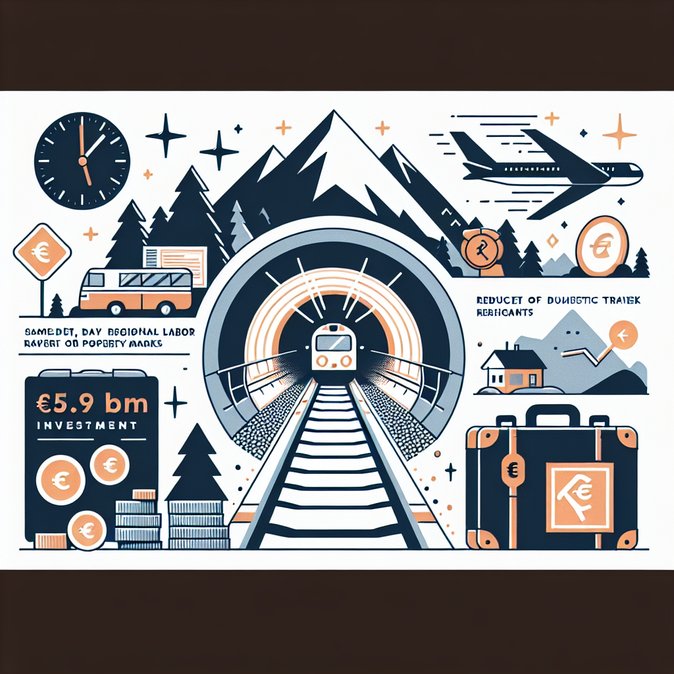
Austria’s long-awaited Koralm Railway carried its first scheduled passengers on Sunday, 14 December 2025, heralding the country’s most significant rail upgrade in more than a century. The 127-kilometre double-track line links the provincial capitals of Graz (Styria) and Klagenfurt (Carinthia) through the 33-kilometre Koralm Tunnel—now one of the world’s longest railway tunnels. After 27 years of construction and a €5.9 billion price-tag—co-financed by more than €600 million from EU funds—the line has instantly cut rail journey times between the two cities from almost three hours to just 41 minutes.
Background and European context: The Koralm Railway forms part of the Baltic–Adriatic TEN-T corridor that will eventually connect Polish and Italian seaports. EU transport officials at the inauguration described the route as a “game-changer” for north–south freight and passenger flows, complementing the Brenner Base Tunnel and the future Semmering Base Tunnel to create a high-speed spine through the Alps. ÖBB (Austrian Federal Railways) confirmed that through-freight trials began in early November; full commercial cargo operations will be phased in once timetable reliability data stabilise.
Practical implications for business travellers: The initial passenger timetable offers 29 daily Graz–Klagenfurt services, with Railjet Xpress trains running at up to 250 km/h. Vienna–Klagenfurt journey times fall by 45 minutes to 3 h 10 min, while Vienna–Graz drops below 2 hours for the first time. Corporate travel managers with operations in Austria’s southern industrial belt (automotive, timber and green-tech clusters) can now schedule same-day meetings that previously required overnight stays. Early-morning Railjet Xpress departures also connect neatly with long-haul flights out of Vienna Airport, reducing the need for short-haul positioning flights and supporting corporate sustainability targets.
![Austria’s €5.9 billion Koralm Railway Enters Service, Slashing Graz–Klagenfurt Travel to 41 Minutes]()
For international passengers keen to capitalise on these quicker connections, VisaHQ can simplify the paperwork by handling Austrian (and wider Schengen) visa applications entirely online—ideal for business travellers on tight schedules. Dedicated account managers, real-time tracking and expedited processing options mean teams can secure travel documents without derailing project timelines. Learn more at https://www.visahq.com/austria/
Economic and regional effects: Regional development agencies expect a new cross-border labour market to emerge, with recruiters marketing jobs in Klagenfurt to Graz-area commuters and vice-versa. Real-estate analysts are already tracking price spikes for residential property near the new Lavanttal and St Paul stations, positioned to serve smaller towns that suddenly sit within a one-hour rail commute of two state capitals. Logistics operators, meanwhile, are reviewing trucking routes as intermodal rail-freight paths become viable across the Alps.
What’s next? The line’s full potential will be unlocked only after the Semmering Base Tunnel (scheduled for 2030) shortens Vienna–Graz to 1 h 40 min, creating a high-speed triangle Vienna–Graz–Klagenfurt. Businesses should therefore view this week’s opening as the first stage of a wider southern-corridor transformation and consider long-term mobility policies—including season-ticket strategies, talent-mobility budgets and green-travel KPIs—accordingly.
Background and European context: The Koralm Railway forms part of the Baltic–Adriatic TEN-T corridor that will eventually connect Polish and Italian seaports. EU transport officials at the inauguration described the route as a “game-changer” for north–south freight and passenger flows, complementing the Brenner Base Tunnel and the future Semmering Base Tunnel to create a high-speed spine through the Alps. ÖBB (Austrian Federal Railways) confirmed that through-freight trials began in early November; full commercial cargo operations will be phased in once timetable reliability data stabilise.
Practical implications for business travellers: The initial passenger timetable offers 29 daily Graz–Klagenfurt services, with Railjet Xpress trains running at up to 250 km/h. Vienna–Klagenfurt journey times fall by 45 minutes to 3 h 10 min, while Vienna–Graz drops below 2 hours for the first time. Corporate travel managers with operations in Austria’s southern industrial belt (automotive, timber and green-tech clusters) can now schedule same-day meetings that previously required overnight stays. Early-morning Railjet Xpress departures also connect neatly with long-haul flights out of Vienna Airport, reducing the need for short-haul positioning flights and supporting corporate sustainability targets.

For international passengers keen to capitalise on these quicker connections, VisaHQ can simplify the paperwork by handling Austrian (and wider Schengen) visa applications entirely online—ideal for business travellers on tight schedules. Dedicated account managers, real-time tracking and expedited processing options mean teams can secure travel documents without derailing project timelines. Learn more at https://www.visahq.com/austria/
Economic and regional effects: Regional development agencies expect a new cross-border labour market to emerge, with recruiters marketing jobs in Klagenfurt to Graz-area commuters and vice-versa. Real-estate analysts are already tracking price spikes for residential property near the new Lavanttal and St Paul stations, positioned to serve smaller towns that suddenly sit within a one-hour rail commute of two state capitals. Logistics operators, meanwhile, are reviewing trucking routes as intermodal rail-freight paths become viable across the Alps.
What’s next? The line’s full potential will be unlocked only after the Semmering Base Tunnel (scheduled for 2030) shortens Vienna–Graz to 1 h 40 min, creating a high-speed triangle Vienna–Graz–Klagenfurt. Businesses should therefore view this week’s opening as the first stage of a wider southern-corridor transformation and consider long-term mobility policies—including season-ticket strategies, talent-mobility budgets and green-travel KPIs—accordingly.
More From Austria
View all
ÖBB and Austrian Airlines Launch AIRail Klagenfurt–Vienna Service, Offering Seamless Train-to-Plane Links

AIRail launches Klagenfurt–Vienna service, giving southern Austria a rail-to-air bridge from 14 December