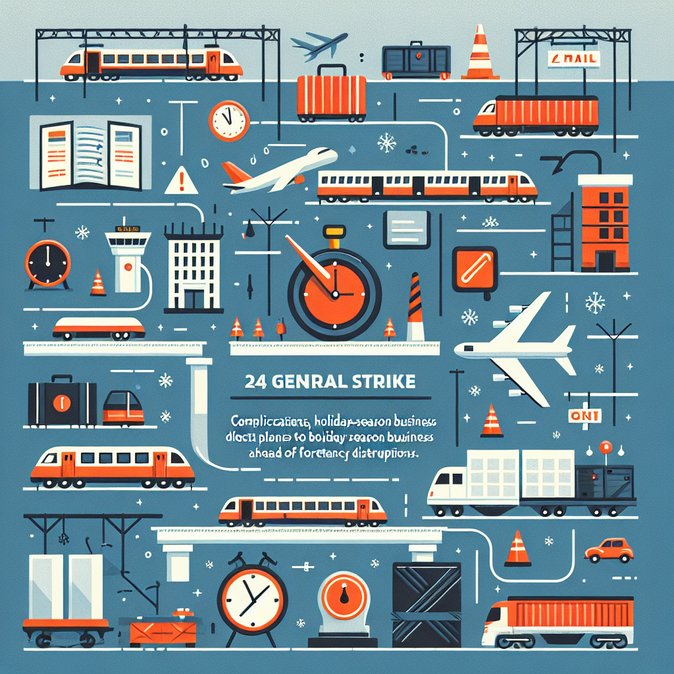
Italy’s largest trade-union federation, CGIL, staged a 24-hour general strike on 12 December that brought much of the country’s passenger and freight network to a standstill. The walk-out—protesting Prime Minister Giorgia Meloni’s 2026 budget—hit long-distance rail, local public transport, ports and some airport ground-handling operations.
Impact snapshot • Trenitalia and Italo cancelled scores of inter-city trains; regional services ran on a sharply reduced timetable. • Key logistics hubs, including the ports of Genoa and Naples, reported container backlogs, while trucking associations warned of delivery delays that could stretch through the weekend. • Rome’s Fiumicino and Milan’s Malpensa airports maintained flight schedules but faced baggage-handling slow-downs and longer security queues.
Business-mobility implications Relocation providers scrambled to re-route assignees via overnight coach services or remote work arrangements. Employers with posted-worker deadlines saw compliance risks escalate as employees were unable to cross regional borders to final worksites. Travel-risk teams highlighted the need for contingency planning ahead of additional sector-specific strikes slated for 17 and 22 December.
![Nationwide Strike Paralyses Italian Transport, Forcing Mobility Teams to Re-Route Travellers]()
Amid the disruption, companies moving staff in and out of Italy may also confront last-minute visa or permit questions. VisaHQ’s Italy portal (https://www.visahq.com/italy/) offers a quick way to check requirements, lodge applications online and track processing in real time, allowing mobility teams to pivot itineraries without derailing compliance or project timelines.
Political backdrop CGIL says 61 % of public- and private-sector workers joined the action, accusing the budget of boosting defence spending while underfunding health care and wage growth. The government dismisses the stoppage as “politically motivated,” but recent opinion polls show Meloni’s approval slipping for the first time since the 2022 election.
What’s next The transport ministry is drafting stricter minimum-service rules that could shorten future strikes to four hours, but unions vow further action unless budget talks reopen. Mobility managers should lock in flexible, fully refundable tickets and monitor local prefecture bulletins, which may impose ad-hoc limits on heavy-goods vehicles entering urban areas during the holiday period.
Impact snapshot • Trenitalia and Italo cancelled scores of inter-city trains; regional services ran on a sharply reduced timetable. • Key logistics hubs, including the ports of Genoa and Naples, reported container backlogs, while trucking associations warned of delivery delays that could stretch through the weekend. • Rome’s Fiumicino and Milan’s Malpensa airports maintained flight schedules but faced baggage-handling slow-downs and longer security queues.
Business-mobility implications Relocation providers scrambled to re-route assignees via overnight coach services or remote work arrangements. Employers with posted-worker deadlines saw compliance risks escalate as employees were unable to cross regional borders to final worksites. Travel-risk teams highlighted the need for contingency planning ahead of additional sector-specific strikes slated for 17 and 22 December.

Amid the disruption, companies moving staff in and out of Italy may also confront last-minute visa or permit questions. VisaHQ’s Italy portal (https://www.visahq.com/italy/) offers a quick way to check requirements, lodge applications online and track processing in real time, allowing mobility teams to pivot itineraries without derailing compliance or project timelines.
Political backdrop CGIL says 61 % of public- and private-sector workers joined the action, accusing the budget of boosting defence spending while underfunding health care and wage growth. The government dismisses the stoppage as “politically motivated,” but recent opinion polls show Meloni’s approval slipping for the first time since the 2022 election.
What’s next The transport ministry is drafting stricter minimum-service rules that could shorten future strikes to four hours, but unions vow further action unless budget talks reopen. Mobility managers should lock in flexible, fully refundable tickets and monitor local prefecture bulletins, which may impose ad-hoc limits on heavy-goods vehicles entering urban areas during the holiday period.