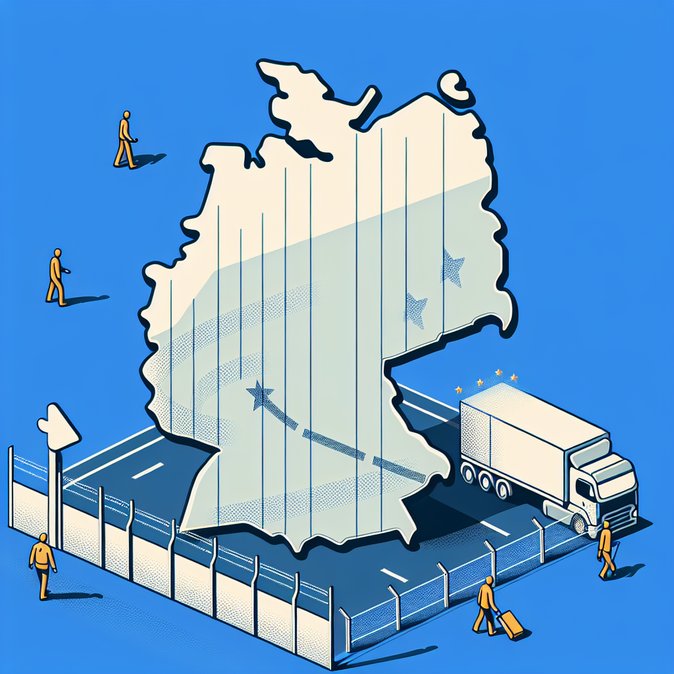
Germany appears poised to wind down the temporary police checks it re-imposed on all nine land frontiers last year. Speaking in Mainz on 10 December, Chancellor Friedrich Merz welcomed the agreement EU interior ministers struck in Brussels a day earlier on the long-negotiated Pact on Migration and Asylum.
The pact would create external “return hubs” for people whose asylum claims are rejected and oblige every member state to contribute either relocations or financial support. For Berlin the deal is politically useful: it promises stricter control at Europe’s outer borders and faster deportations, allowing Germany to step back from politically sensitive internal checks that have angered commuters, exporters and neighbouring governments.
Border controls were first re-introduced in September 2024 by the Scholz government in response to a sharp rise in irregular entries. Merz’s administration extended them in May 2025 and paired them with tougher police powers and a drive to reject most asylum seekers at the frontier. Logistics firms say the controls add €90-€120 in direct costs per truck run, while automotive plants in Bavaria have reported parts delays of up to six hours.
![Merz signals end to German border checks after EU migration overhaul]()
To minimise the administrative friction that persists even as physical checks ease, many businesses and frequent travellers rely on specialised facilitators. VisaHQ’s Germany portal (https://www.visahq.com/germany/) streamlines visa, passport and document-legalisation procedures, offering real-time guidance that helps employers, drivers and consultants compile compliant paperwork quickly and avoid costly border surprises.
Officials at the Federal Police say a phased wind-down could start as soon as the new EU rules receive final parliamentary approval in spring 2026, with spot checks replacing systematic controls. Companies dependent on just-in-time supply chains are already preparing revised routing plans and advising internationally assigned staff to keep passports on hand until the formal lifting is announced.
Immigration lawyers caution that an end to border checks will not change employers’ duty to verify work and residence rights, but they expect a smoother flow of posted workers and intra-EU business travellers by the second half of 2026.
The pact would create external “return hubs” for people whose asylum claims are rejected and oblige every member state to contribute either relocations or financial support. For Berlin the deal is politically useful: it promises stricter control at Europe’s outer borders and faster deportations, allowing Germany to step back from politically sensitive internal checks that have angered commuters, exporters and neighbouring governments.
Border controls were first re-introduced in September 2024 by the Scholz government in response to a sharp rise in irregular entries. Merz’s administration extended them in May 2025 and paired them with tougher police powers and a drive to reject most asylum seekers at the frontier. Logistics firms say the controls add €90-€120 in direct costs per truck run, while automotive plants in Bavaria have reported parts delays of up to six hours.
To minimise the administrative friction that persists even as physical checks ease, many businesses and frequent travellers rely on specialised facilitators. VisaHQ’s Germany portal (https://www.visahq.com/germany/) streamlines visa, passport and document-legalisation procedures, offering real-time guidance that helps employers, drivers and consultants compile compliant paperwork quickly and avoid costly border surprises.
Officials at the Federal Police say a phased wind-down could start as soon as the new EU rules receive final parliamentary approval in spring 2026, with spot checks replacing systematic controls. Companies dependent on just-in-time supply chains are already preparing revised routing plans and advising internationally assigned staff to keep passports on hand until the formal lifting is announced.
Immigration lawyers caution that an end to border checks will not change employers’ duty to verify work and residence rights, but they expect a smoother flow of posted workers and intra-EU business travellers by the second half of 2026.