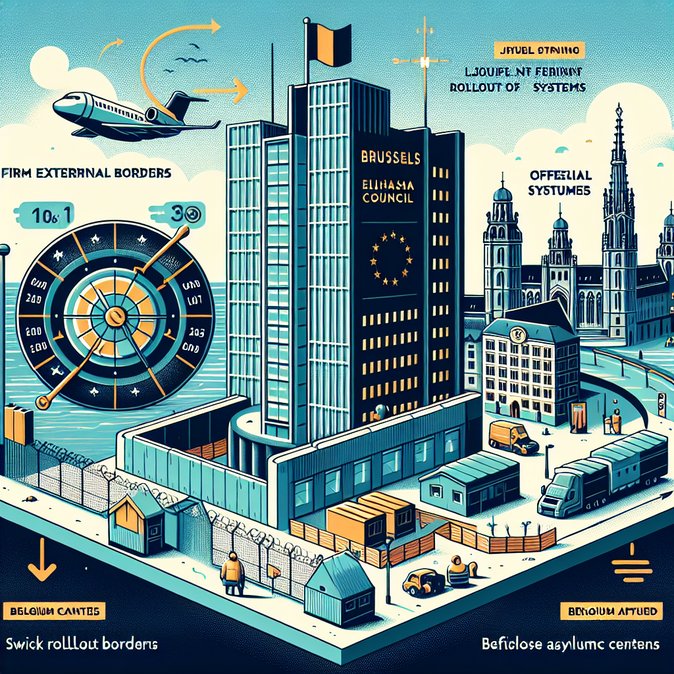
Meeting in Brussels on 8-9 December 2025, the Justice and Home Affairs (JHA) Council reached a long-awaited political agreement on three inter-linked pieces of migration legislation: a revised Return Regulation, a list of safe countries of origin and amendments that make it easier for member states to deem asylum applications inadmissible if protection could have been sought in a ‘safe third country’.
The package, championed by the Danish Presidency, is designed to tackle the perennial problem that only around 20 % of rejected asylum seekers are actually removed from EU territory. Under the new rules, a common EU Return Order will accompany national decisions, allowing any Schengen state to enforce another’s order without starting a fresh procedure. The reforms also oblige migrants to cooperate—providing fingerprints and travel documents—or face detention for up to 12 months.
For Belgium, whose Federal Asylum Office processed a record 37,000 applications in 2024, faster returns could ease reception-centre overcrowding and reduce the controversial practice of placing asylum seekers in hotel accommodation. Belgian Secretary of State for Asylum and Migration Anneleen Van Bossuyt welcomed the deal, saying it “aligns with our domestic objective of restoring credibility to the asylum system by ensuring those without protection needs leave quickly.”
![EU justice ministers in Brussels strike deal to accelerate returns and widen ‘safe third country’ concept]()
Individuals and businesses needing to navigate Belgian visa requirements in light of these evolving policies can turn to VisaHQ for quick, expert assistance. The platform’s Belgium page (https://www.visahq.com/belgium/) offers real-time guidance, streamlined application tools, and personalized support—helping travelers and corporate mobility teams stay compliant as new EU rules roll out.
The Council additionally endorsed an expanded ‘safe country of origin’ list—including Bangladesh, Egypt and Tunisia—and updated criteria for designating ‘safe third countries.’ This gives Belgium’s asylum office more latitude to reject claims from nationals of those countries or to transfer applicants to partner states deemed safe.
Business-mobility stakeholders should monitor implementation timelines. While the reforms chiefly target irregular migration, the broader definition of ‘safe countries’ could influence visa policy and transit rules, potentially affecting short-term assignees and contractors from newly listed states. Final trilogue negotiations with the European Parliament are expected early in 2026, with the Regulation slated to enter into force mid-2027.
The package, championed by the Danish Presidency, is designed to tackle the perennial problem that only around 20 % of rejected asylum seekers are actually removed from EU territory. Under the new rules, a common EU Return Order will accompany national decisions, allowing any Schengen state to enforce another’s order without starting a fresh procedure. The reforms also oblige migrants to cooperate—providing fingerprints and travel documents—or face detention for up to 12 months.
For Belgium, whose Federal Asylum Office processed a record 37,000 applications in 2024, faster returns could ease reception-centre overcrowding and reduce the controversial practice of placing asylum seekers in hotel accommodation. Belgian Secretary of State for Asylum and Migration Anneleen Van Bossuyt welcomed the deal, saying it “aligns with our domestic objective of restoring credibility to the asylum system by ensuring those without protection needs leave quickly.”

Individuals and businesses needing to navigate Belgian visa requirements in light of these evolving policies can turn to VisaHQ for quick, expert assistance. The platform’s Belgium page (https://www.visahq.com/belgium/) offers real-time guidance, streamlined application tools, and personalized support—helping travelers and corporate mobility teams stay compliant as new EU rules roll out.
The Council additionally endorsed an expanded ‘safe country of origin’ list—including Bangladesh, Egypt and Tunisia—and updated criteria for designating ‘safe third countries.’ This gives Belgium’s asylum office more latitude to reject claims from nationals of those countries or to transfer applicants to partner states deemed safe.
Business-mobility stakeholders should monitor implementation timelines. While the reforms chiefly target irregular migration, the broader definition of ‘safe countries’ could influence visa policy and transit rules, potentially affecting short-term assignees and contractors from newly listed states. Final trilogue negotiations with the European Parliament are expected early in 2026, with the Regulation slated to enter into force mid-2027.