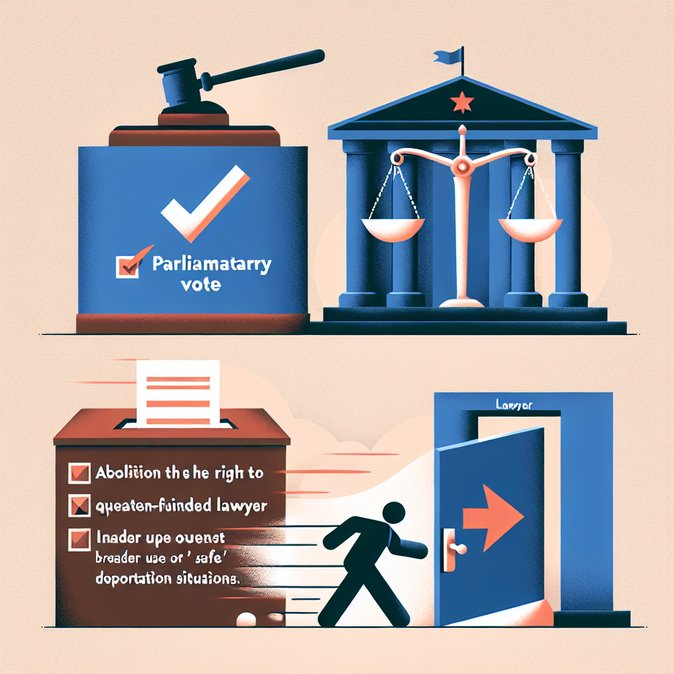
Meeting in Brussels on 8 December, EU home-affairs ministers—led by Germany’s Alexander Dobrindt, holder of the rotating presidency—agreed their final negotiating position on two cornerstone files of the Pact on Migration and Asylum. The first sets up a standardised screening procedure and empowers member states to refuse applicants who could obtain protection in a designated ‘safe’ third country. The second harmonises return rules, enabling longer detention (up to 18 months) for migrants who ignore voluntary-departure orders and creating EU-funded “return hubs” outside the bloc.
For Germany, the deal dovetails neatly with the Bundestag’s own reforms adopted the same weekend. Officials in Berlin confirmed that the federal police will pilot the new rules at Frankfurt and Munich airports from March 2026—well ahead of full EU entry-into-force—by routing manifestly unfounded claims to accelerated border procedures. Companies that post staff to Germany from Bangladesh, Egypt, India or Tunisia—the four largest economies now labelled “safe” at EU level—will need to watch for knock-on effects such as tighter document scrutiny or higher proof-of-return bonds.
![EU ministers back asylum overhaul and common 'safe-country' list; Berlin prepares rapid implementation]()
Business groups broadly support the creation of a single list, arguing that divergent national designations currently cause uncertainty when transferring employees across Schengen. Human-rights organisations, however, fear that outsourcing returns to non-EU “hubs” will erode safeguards and expose families to poor conditions. The European Parliament must still sign off, but German MEPs from the CDU/CSU and FDP have signalled support, while the Greens plan amendments limiting child detention.
Amid these shifting requirements, employers and travellers can streamline compliance by partnering with a specialist such as VisaHQ. The service tracks legislative updates in real time and can arrange German visas, residence permits and return documentation on clients’ behalf—minimising administrative risk as the safe-country list and detention rules evolve. Full details are available at https://www.visahq.com/germany/
Assuming a first-reading deal in early 2026, Germany intends to incorporate the regulations into domestic law via statutory instrument, bypassing lengthy parliamentary debate. Multinationals should therefore review internal mobility and duty-of-care policies now, particularly when assigning staff who hold passports from countries on the forthcoming safe-country list.
For Germany, the deal dovetails neatly with the Bundestag’s own reforms adopted the same weekend. Officials in Berlin confirmed that the federal police will pilot the new rules at Frankfurt and Munich airports from March 2026—well ahead of full EU entry-into-force—by routing manifestly unfounded claims to accelerated border procedures. Companies that post staff to Germany from Bangladesh, Egypt, India or Tunisia—the four largest economies now labelled “safe” at EU level—will need to watch for knock-on effects such as tighter document scrutiny or higher proof-of-return bonds.

Business groups broadly support the creation of a single list, arguing that divergent national designations currently cause uncertainty when transferring employees across Schengen. Human-rights organisations, however, fear that outsourcing returns to non-EU “hubs” will erode safeguards and expose families to poor conditions. The European Parliament must still sign off, but German MEPs from the CDU/CSU and FDP have signalled support, while the Greens plan amendments limiting child detention.
Amid these shifting requirements, employers and travellers can streamline compliance by partnering with a specialist such as VisaHQ. The service tracks legislative updates in real time and can arrange German visas, residence permits and return documentation on clients’ behalf—minimising administrative risk as the safe-country list and detention rules evolve. Full details are available at https://www.visahq.com/germany/
Assuming a first-reading deal in early 2026, Germany intends to incorporate the regulations into domestic law via statutory instrument, bypassing lengthy parliamentary debate. Multinationals should therefore review internal mobility and duty-of-care policies now, particularly when assigning staff who hold passports from countries on the forthcoming safe-country list.
More From Germany
View all
Bundestag strips migrants in detention of automatic legal counsel and lets Interior Ministry label ‘safe countries’ by decree

German foreign minister begins first China visit, signalling closer scrutiny of trade dependencies and new travel protocols