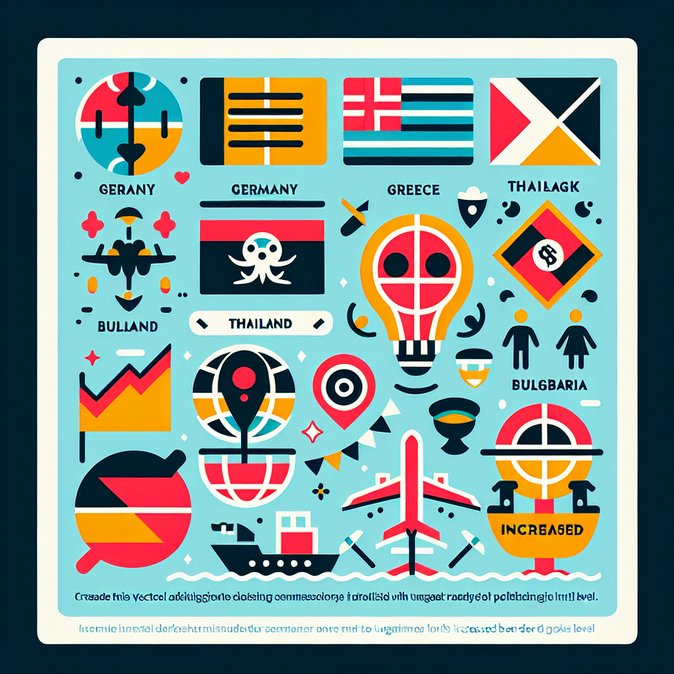
The German Federal Foreign Office (AA) updated its ‘Sicher Reisen’ portal on 7 December 2025, warning citizens about escalations in four popular winter-sun destinations. The advisory cites political protests in Greece, separatist violence in southern Thailand, street demonstrations and tighter border checks in Bulgaria, and an extended state of emergency in Trinidad and Tobago.
For the first time the AA explicitly links the warnings to new “mandatory ID-upgrade” rules: German travellers may be asked for electronic passports or EU national ID cards at random roadblocks, ferry terminals and regional airports. The ministry also cautions that sudden curfews or public-order decrees could force tourists to change itineraries at short notice.
Corporate travel managers are advised to update risk-assessment matrices, ensure employees enrol in the Foreign Office’s ELEFAND tracking system, and verify that local partners can provide 24/7 support. Insurance providers note that failure to follow official advice could void certain medical-evacuation clauses. Airlines have not announced schedule changes, but travel agencies report a spike in voluntary re-bookings to Spain and the Canary Islands.
![Foreign Office issues urgent travel alerts for Greece, Thailand, Bulgaria and Trinidad & Tobago amid rising security risks]()
Faced with these rapidly shifting ID and visa requirements, many organisations rely on VisaHQ to keep their travellers compliant. The service’s German portal (https://www.visahq.com/germany/) offers instant eligibility checks, expedited passport renewals and end-to-end visa processing, giving corporate mobility teams a single dashboard to manage documentation even in high-risk or fast-changing destinations.
The alert underscores a broader trend: the AA has already issued 28 high-level warnings in 2025, a 40 % rise year-on-year, reflecting what officials call a “poly-crisis travel environment.” Mobility teams should expect more granular, destination-specific guidance and budget for pre-trip security briefings even for traditionally leisure-oriented markets.
Although the advisory is not a formal travel ban, businesses with operations in shipping, energy or agritech – sectors that frequently send German staff to Thessaloniki, Bangkok or Port-of-Spain – should review contingency plans, consider split-team deployments and maintain real-time comms channels. Expats already on the ground are urged to register with local embassies and limit non-essential movement during demonstrations.
For the first time the AA explicitly links the warnings to new “mandatory ID-upgrade” rules: German travellers may be asked for electronic passports or EU national ID cards at random roadblocks, ferry terminals and regional airports. The ministry also cautions that sudden curfews or public-order decrees could force tourists to change itineraries at short notice.
Corporate travel managers are advised to update risk-assessment matrices, ensure employees enrol in the Foreign Office’s ELEFAND tracking system, and verify that local partners can provide 24/7 support. Insurance providers note that failure to follow official advice could void certain medical-evacuation clauses. Airlines have not announced schedule changes, but travel agencies report a spike in voluntary re-bookings to Spain and the Canary Islands.

Faced with these rapidly shifting ID and visa requirements, many organisations rely on VisaHQ to keep their travellers compliant. The service’s German portal (https://www.visahq.com/germany/) offers instant eligibility checks, expedited passport renewals and end-to-end visa processing, giving corporate mobility teams a single dashboard to manage documentation even in high-risk or fast-changing destinations.
The alert underscores a broader trend: the AA has already issued 28 high-level warnings in 2025, a 40 % rise year-on-year, reflecting what officials call a “poly-crisis travel environment.” Mobility teams should expect more granular, destination-specific guidance and budget for pre-trip security briefings even for traditionally leisure-oriented markets.
Although the advisory is not a formal travel ban, businesses with operations in shipping, energy or agritech – sectors that frequently send German staff to Thessaloniki, Bangkok or Port-of-Spain – should review contingency plans, consider split-team deployments and maintain real-time comms channels. Expats already on the ground are urged to register with local embassies and limit non-essential movement during demonstrations.
More From Germany
View all
Bundestag scraps mandatory legal counsel in deportation detention and gives government sole power to declare ‘safe countries’
Germany’s new ‘Chancenkarte’ and other skilled-migration tools under-perform, Green Party slams lack of ‘welcome culture’