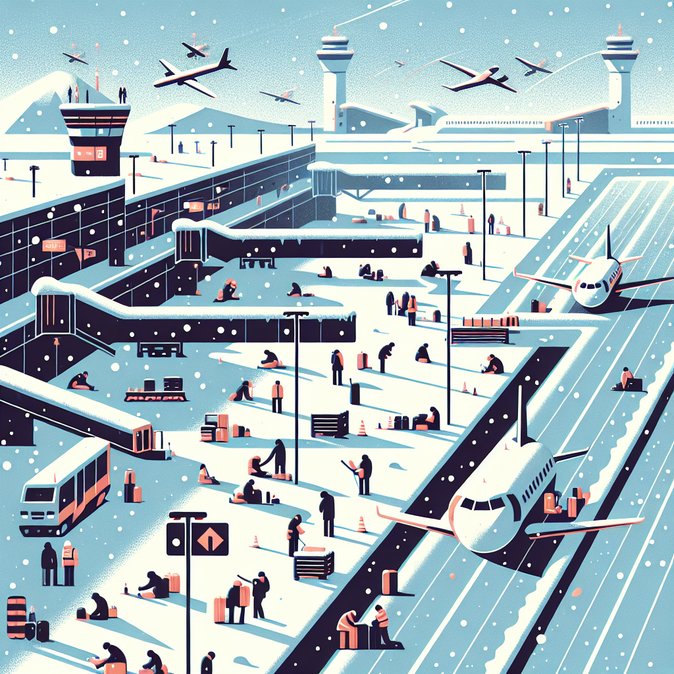
A fast-moving winter storm blanketed southern Germany and the northern Alps on 5 December, forcing airlines to pre-emptively trim schedules at Munich Airport (MUC). Lufthansa cancelled at least one afternoon rotation to Vienna (OS/LH codeshare) and its regional partner Air Dolomiti scrubbed flight EN 8056 to Graz. Runway contamination and low visibility prompted the airport to activate Category III low-visibility procedures, slowing operations.
The timing could not be worse: the first Advent weekend is traditionally one of the busiest for both business travellers wrapping up year-end trips and leisure passengers heading to Christmas markets. Airport officials said more cancellations were possible if de-icing backlogs grew. Austrian Railways (ÖBB) reported a sharp spike in Railjet bookings on the Munich–Vienna corridor but warned that seats were “close to sold out”, leaving stranded passengers with few alternatives.
![Snowstorm Disrupts Munich Hub, Cancels Lufthansa & Air Dolomiti Flights to Vienna and Graz]()
Corporate-travel managers are advising staff to re-route via Zurich or Prague, or to switch to rail where feasible. Airlines have activated EU 261 rebooking policies, but premium-cabin inventory for 6–7 December is already tight. Mobility teams should also watch knock-on effects at Frankfurt, where several inbound crews are rostered to operate Munich legs.
Longer term, the disruption has renewed calls from Vienna International Airport for aviation-tax reform, arguing that high charges discourage carriers from basing spare aircraft in the region—reducing resilience when weather strikes.
The timing could not be worse: the first Advent weekend is traditionally one of the busiest for both business travellers wrapping up year-end trips and leisure passengers heading to Christmas markets. Airport officials said more cancellations were possible if de-icing backlogs grew. Austrian Railways (ÖBB) reported a sharp spike in Railjet bookings on the Munich–Vienna corridor but warned that seats were “close to sold out”, leaving stranded passengers with few alternatives.

Corporate-travel managers are advising staff to re-route via Zurich or Prague, or to switch to rail where feasible. Airlines have activated EU 261 rebooking policies, but premium-cabin inventory for 6–7 December is already tight. Mobility teams should also watch knock-on effects at Frankfurt, where several inbound crews are rostered to operate Munich legs.
Longer term, the disruption has renewed calls from Vienna International Airport for aviation-tax reform, arguing that high charges discourage carriers from basing spare aircraft in the region—reducing resilience when weather strikes.