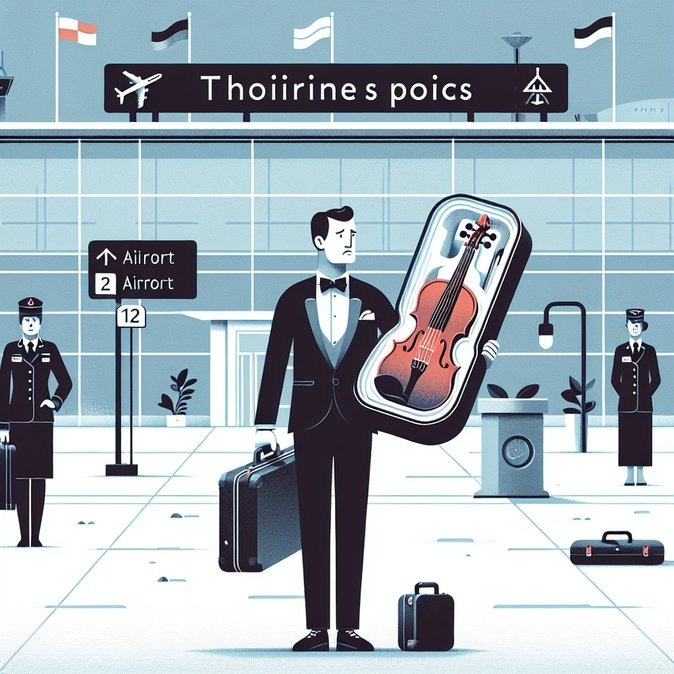
An unusual air-travel dispute on 3 December 2025 put Helsinki Airport and German carrier Lufthansa in the spotlight after renowned soloist Carolin Widmann was told she could not board with her 243-year-old Guadagnini violin inside its protective case. Check-in staff deemed the slim but 80-centimetre-long case too large for cabin baggage and – with no extra seat available on a connecting Frankfurt–Leipzig segment – offered three options: place the instrument in the hold, buy an additional seat for the entire itinerary, or carry the violin ‘bare’.
Widmann, fearing temperature and pressure damage in the hold, reluctantly chose the last option, wrapping the multimillion-euro instrument in a sweater and holding it by hand throughout the journey. Cabin crew later found secure stowage on board, but the incident drew sharp criticism from the global music community and Finland’s performing-arts sector, which counts on smooth air links to sustain its busy winter concert season.
![Historic violin incident at Helsinki Airport reignites debate over airline rules for fragile items]()
Context and regulations. Lufthansa’s published policy allows musical instruments within 55 × 40 × 23 cm and 8 kg; larger instruments usually require a second seat. Industry groups note that ground staff often exercise discretion when overhead-bin space is plentiful. At Helsinki, however, a strict interpretation prevailed, highlighting inconsistencies in how airlines apply their own rules across stations.
Implications for Finnish mobility stakeholders. • Helsinki-based orchestras planning tours may need to budget for extra seats or freight charges, adding cost to already tight cultural budgets. • Business-travel managers should review airline policies covering specialised equipment – from prototype tech to medical devices – to avoid last-minute gate disputes. • The episode could spur Finavia and local carriers such as Finnair to clarify their own guidelines and training for handling fragile or high-value cabin items.
Next steps. Lufthansa said it will review the case internally, while Finland’s Musicians’ Union called for EU-level guidelines modelled on the United States’ FAA rules, which guarantee cabin acceptance of small instruments when space is available. The Ministry of Transport and Communications confirmed it will raise the matter at the next Nordic Aviation Forum.
Widmann, fearing temperature and pressure damage in the hold, reluctantly chose the last option, wrapping the multimillion-euro instrument in a sweater and holding it by hand throughout the journey. Cabin crew later found secure stowage on board, but the incident drew sharp criticism from the global music community and Finland’s performing-arts sector, which counts on smooth air links to sustain its busy winter concert season.

Context and regulations. Lufthansa’s published policy allows musical instruments within 55 × 40 × 23 cm and 8 kg; larger instruments usually require a second seat. Industry groups note that ground staff often exercise discretion when overhead-bin space is plentiful. At Helsinki, however, a strict interpretation prevailed, highlighting inconsistencies in how airlines apply their own rules across stations.
Implications for Finnish mobility stakeholders. • Helsinki-based orchestras planning tours may need to budget for extra seats or freight charges, adding cost to already tight cultural budgets. • Business-travel managers should review airline policies covering specialised equipment – from prototype tech to medical devices – to avoid last-minute gate disputes. • The episode could spur Finavia and local carriers such as Finnair to clarify their own guidelines and training for handling fragile or high-value cabin items.
Next steps. Lufthansa said it will review the case internally, while Finland’s Musicians’ Union called for EU-level guidelines modelled on the United States’ FAA rules, which guarantee cabin acceptance of small instruments when space is available. The Ministry of Transport and Communications confirmed it will raise the matter at the next Nordic Aviation Forum.
More From Finland
View all
EU links trade preferences to migrant returns, impacting Finland’s readmission diplomacy
European Parliament scrutinises Frontex deal with Bosnia-Herzegovina amid Finnish concerns over external-border pressure