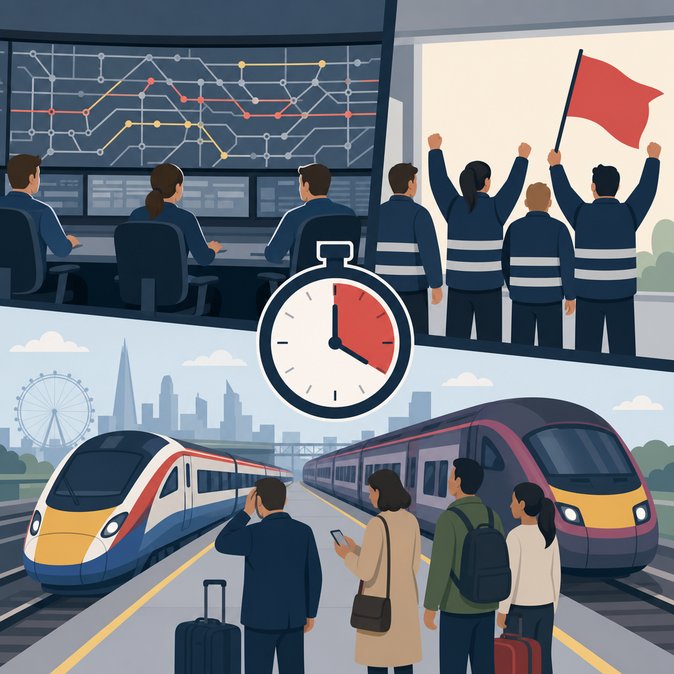
Industrial action by TSSA-represented control staff at West Midlands Trains brought large parts of the London Northwestern Railway (LNR) and West Midlands Railway (WMR) networks to a standstill on 22–23 May – the first of two bank-holiday weekends book-ending the half-term break. National Rail Enquiries listed the dispute as a “major incident” on its live status board published at 09:00 on Saturday.
![Rail strike cripples London Northwestern and West Midlands services on peak getaway day]()
For international employees or visitors caught up in travel chaos like this, VisaHQ can take at least one headache off the table. Its online portal (https://www.visahq.com/united-kingdom/) provides up-to-date entry requirements and expedited UK visa processing, allowing mobility teams to re-route staff quickly while staying compliant with border rules.
Only one train per hour ran on key inter-city corridors linking London Euston with Birmingham New Street, Northampton and Crewe, while branch lines such as the Marston Vale and Abbey routes were suspended entirely. Strike organisers say the 24-hour walk-out follows a breakdown in talks over duty rosters and the company’s plan to merge some control functions after renationalisation earlier this year. Business-traveller impact was immediate: Virgin Trains told corporates to rebook via Chiltern or Avanti routes, adding up to 90 minutes to end-to-end journeys. Hospitality providers reported dozens of event cancellations in Birmingham and Milton Keynes. Logistics firms highlighted knock-on effects on driver availability because staff booked onto unavailable commuter services could not reach distribution hubs. LNR urged passengers to “travel only if essential” and will not operate any replacement buses, citing nationwide driver shortages. Employers with time-critical weekend assignments were forced to fund short-notice car-hire and hotel stays. Unions have not ruled out further stoppages over the summer, prompting mobility managers to consider contingency rail passes via alternative operators. The dispute comes amid a broader wave of sectoral unrest: National Rail’s own dashboard shows 18 separate rail strikes and 20 airport-related actions scheduled for May alone. HR directors are being advised to update duty-of-care plans, particularly for junior assignees unfamiliar with the UK rail landscape.

For international employees or visitors caught up in travel chaos like this, VisaHQ can take at least one headache off the table. Its online portal (https://www.visahq.com/united-kingdom/) provides up-to-date entry requirements and expedited UK visa processing, allowing mobility teams to re-route staff quickly while staying compliant with border rules.
Only one train per hour ran on key inter-city corridors linking London Euston with Birmingham New Street, Northampton and Crewe, while branch lines such as the Marston Vale and Abbey routes were suspended entirely. Strike organisers say the 24-hour walk-out follows a breakdown in talks over duty rosters and the company’s plan to merge some control functions after renationalisation earlier this year. Business-traveller impact was immediate: Virgin Trains told corporates to rebook via Chiltern or Avanti routes, adding up to 90 minutes to end-to-end journeys. Hospitality providers reported dozens of event cancellations in Birmingham and Milton Keynes. Logistics firms highlighted knock-on effects on driver availability because staff booked onto unavailable commuter services could not reach distribution hubs. LNR urged passengers to “travel only if essential” and will not operate any replacement buses, citing nationwide driver shortages. Employers with time-critical weekend assignments were forced to fund short-notice car-hire and hotel stays. Unions have not ruled out further stoppages over the summer, prompting mobility managers to consider contingency rail passes via alternative operators. The dispute comes amid a broader wave of sectoral unrest: National Rail’s own dashboard shows 18 separate rail strikes and 20 airport-related actions scheduled for May alone. HR directors are being advised to update duty-of-care plans, particularly for junior assignees unfamiliar with the UK rail landscape.