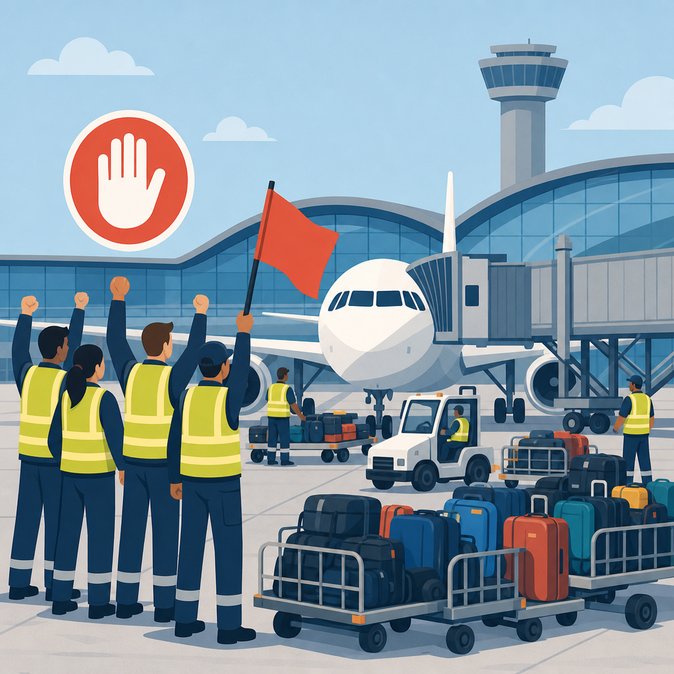
Unions representing ground handlers, security-badge staff and retail workers at Paris-Charles de Gaulle (CDG) have filed a 24-hour strike notice for Tuesday 18 June, citing tighter rules for obtaining and renewing airport-security passes. The walk-out, announced in the early hours of Saturday, raises the prospect of check-in delays, slower aircraft turn-arounds and baggage backlogs at France’s primary international hub. Unlike previous French airport stoppages, the action does not involve air-traffic controllers, meaning runways will stay open and slot capacity should be preserved. Nevertheless, analysts warn that even a partial reduction in ramp manpower can cascade into widespread knock-on delays because CDG functions as a pivotal connection point for Air France–KLM’s long-haul network and the SkyTeam alliance. Peak-hour services to London-Heathrow, New York-JFK, Dubai and key African capitals are considered most at risk.
![Ground-Staff Strike Announced for 18 June at Paris-Charles de Gaulle Airport]()
If the strike forces you to reroute through alternative hubs or adjust your travel dates, remember that itinerary changes can sometimes trigger new visa or transit requirements. VisaHQ’s online platform (https://www.visahq.com/france/) lets both individual travellers and corporate travel managers run instant entry-rule checks, arrange fast-track processing and even schedule courier pick-ups for passports, ensuring documentation is never the weak link during operational disruptions like those expected at CDG.
Corporates with expatriate rotations or high-stakes business meetings around the strike date should encourage travellers to take the first wave of flights where ground operations are typically better resourced, travel light to minimise checked baggage, and leave at least a four-hour buffer for onward rail or road connections from Paris. Airlines have yet to publish re-accommodation policies, but past disputes suggest voluntary rebooking waivers 48 hours either side of the strike are likely. The industrial dispute also shines a light on France’s new background-check regime for secure-zone badge holders – a response to EU aviation-security directives that require enhanced vetting of anyone with airside access. While the government insists the rules are proportionate, unions argue that the heavier paperwork and shrinking validity period for badges create an administrative bottleneck that could worsen staff shortages as the busy summer season approaches.

If the strike forces you to reroute through alternative hubs or adjust your travel dates, remember that itinerary changes can sometimes trigger new visa or transit requirements. VisaHQ’s online platform (https://www.visahq.com/france/) lets both individual travellers and corporate travel managers run instant entry-rule checks, arrange fast-track processing and even schedule courier pick-ups for passports, ensuring documentation is never the weak link during operational disruptions like those expected at CDG.
Corporates with expatriate rotations or high-stakes business meetings around the strike date should encourage travellers to take the first wave of flights where ground operations are typically better resourced, travel light to minimise checked baggage, and leave at least a four-hour buffer for onward rail or road connections from Paris. Airlines have yet to publish re-accommodation policies, but past disputes suggest voluntary rebooking waivers 48 hours either side of the strike are likely. The industrial dispute also shines a light on France’s new background-check regime for secure-zone badge holders – a response to EU aviation-security directives that require enhanced vetting of anyone with airside access. While the government insists the rules are proportionate, unions argue that the heavier paperwork and shrinking validity period for badges create an administrative bottleneck that could worsen staff shortages as the busy summer season approaches.