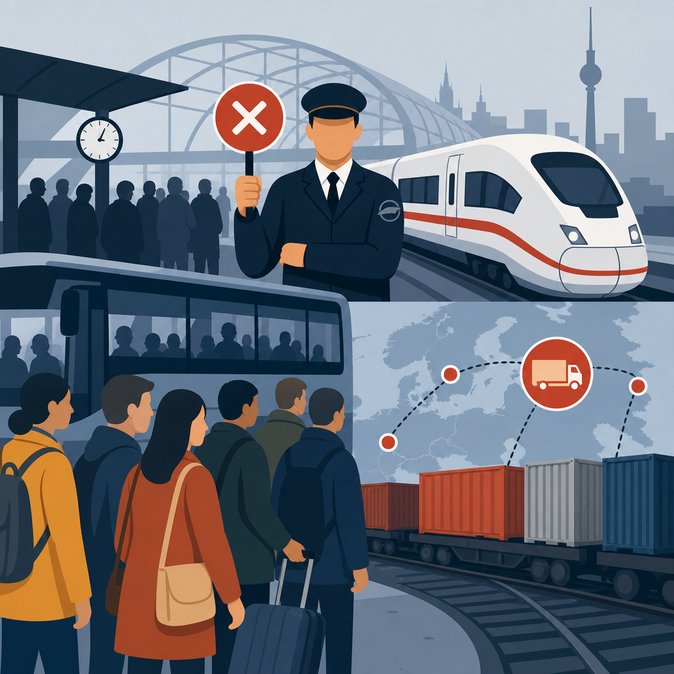
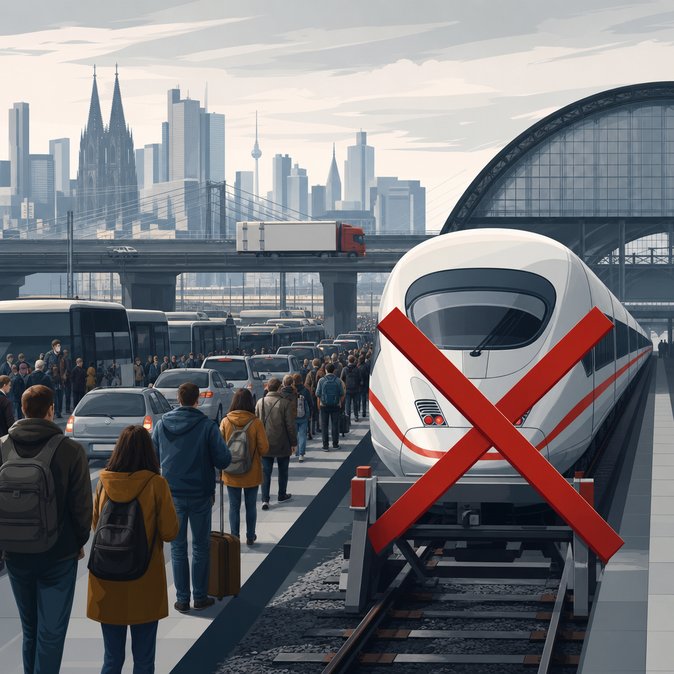
Germany’s transport network faced widespread disruption on 23 May as a six-day national strike by the Train Drivers’ Union (GDL) entered its fourth day, with Deutsche Bahn reporting the cancellation of roughly 80 % of ICE and InterCity services. Regional timetables were also heavily reduced, and knock-on effects spread to Austria, Poland and Scandinavian freight corridors.
![Nation-Wide Rail Strike Cancels 80 % of Long-Distance Trains Across Germany]()
VisaHQ can help mitigate the administrative side of these last-minute itinerary changes. Through its online portal (https://www.visahq.com/germany/), travellers can quickly verify visa requirements for Germany and neighbouring countries, obtain the necessary documentation, and avoid further delays when rerouting via airports or road crossings in the wider Schengen area.
The walk-out centres on pay rises to offset inflation and a demand to shorten the standard working week from 38 to 35 hours. Employers have offered staggered increases totalling 10 %, but GDL is holding out for 14 % plus a one-off cost-of-living bonus. Talks collapsed late Thursday, triggering the union’s longest action since 2024. For mobility programmes the impact is immediate: travellers are being urged to switch to domestic flights or long-distance coaches, but those alternatives are nearing capacity ahead of Whit Monday. Deutsche Bahn has lifted re-booking fees and is honouring rail tickets on later dates, yet EC 261 compensation does not apply because strikes count as “extraordinary circumstances.” Companies with time-critical cargo should consider diverting through Rotterdam or using trucking routes via the A3 and A7, though heavy congestion is expected at weekend construction zones. The strike is scheduled to end at 23:59 on 25 May, but GDL warned of further action if no compromise is reached—leaving business travellers and commuters in limbo as Germany heads into the summer peak.
VisaHQ can help mitigate the administrative side of these last-minute itinerary changes. Through its online portal (https://www.visahq.com/germany/), travellers can quickly verify visa requirements for Germany and neighbouring countries, obtain the necessary documentation, and avoid further delays when rerouting via airports or road crossings in the wider Schengen area.
The walk-out centres on pay rises to offset inflation and a demand to shorten the standard working week from 38 to 35 hours. Employers have offered staggered increases totalling 10 %, but GDL is holding out for 14 % plus a one-off cost-of-living bonus. Talks collapsed late Thursday, triggering the union’s longest action since 2024. For mobility programmes the impact is immediate: travellers are being urged to switch to domestic flights or long-distance coaches, but those alternatives are nearing capacity ahead of Whit Monday. Deutsche Bahn has lifted re-booking fees and is honouring rail tickets on later dates, yet EC 261 compensation does not apply because strikes count as “extraordinary circumstances.” Companies with time-critical cargo should consider diverting through Rotterdam or using trucking routes via the A3 and A7, though heavy congestion is expected at weekend construction zones. The strike is scheduled to end at 23:59 on 25 May, but GDL warned of further action if no compromise is reached—leaving business travellers and commuters in limbo as Germany heads into the summer peak.