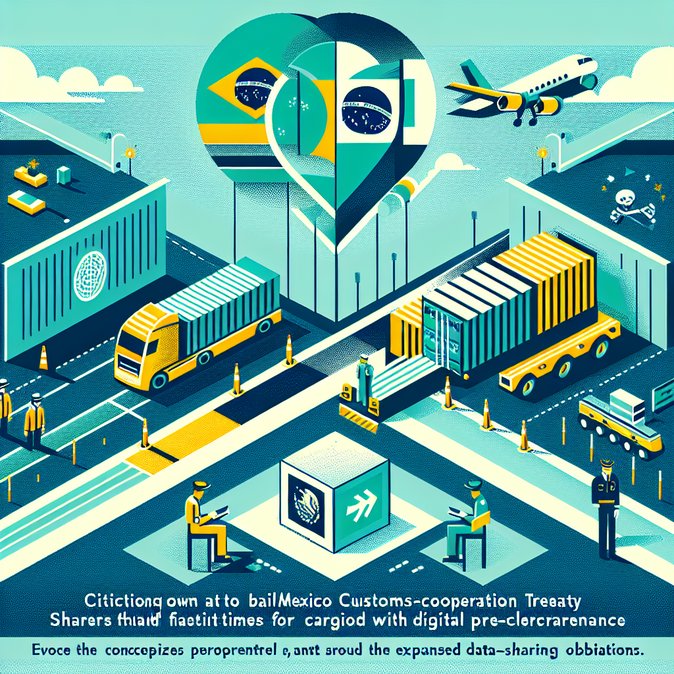
Decree No. 12 862, published on 3 March 2026, promulgates the long-delayed Cooperation and Mutual Administrative Assistance Agreement in Customs Matters between Brazil and Mexico, originally signed in Puerto Vallarta in 2018. While the accord is primarily aimed at combating smuggling and tariff evasion, it also introduces mutually recognised “authorised economic operator” (AEO) corridors and pre-arrival data exchanges that will significantly shorten clearance times for company personnel escorting high-value cargo across both borders.
![Brazil–Mexico customs-cooperation pact promises faster border clearance for supply-chain travellers]()
Organisations that still need help interpreting the visa and documentation implications of these new fast-track channels can turn to VisaHQ, whose dedicated Brazil portal (https://www.visahq.com/brazil/) streamlines courier visas, crew permits and passport renewals; the platform’s API can even sync with AEO databases to preload Customs Escort ID data, saving mobility teams additional admin time.
Under the new framework, Brazilian exporters holding AEO certification can submit digital cargo manifests 24 hours before loading and receive a “green channel” designation valid for both goods and accompanying transfer staff at major Mexican airports and maritime terminals. Conversely, Mexican AEO firms will gain streamlined treatment at Viracopos and Santos. Pilot tests conducted in February reduced average physical inspections from 48 hours to eight, according to Receita Federal. For global mobility managers, the biggest win is the introduction of verifiable “Customs Escort IDs” that function as fast-track passes for logistics engineers, aviation couriers and on-board messengers who frequently shuttle between São Paulo and Querétaro aerospace hubs. These escorts previously required ad-hoc visa letters and often faced secondary screening; the new electronic credential, tied to the traveller’s passport and employer AEO number, should cut airport dwell times by up to 60 %. However, compliance teams must integrate the agreement’s enhanced data-sharing clauses into privacy impact assessments, as both customs authorities can now request six years of historical shipment data linked to individual employees. Companies are advised to review data-minimisation policies and update traveller consent forms accordingly.

Organisations that still need help interpreting the visa and documentation implications of these new fast-track channels can turn to VisaHQ, whose dedicated Brazil portal (https://www.visahq.com/brazil/) streamlines courier visas, crew permits and passport renewals; the platform’s API can even sync with AEO databases to preload Customs Escort ID data, saving mobility teams additional admin time.
Under the new framework, Brazilian exporters holding AEO certification can submit digital cargo manifests 24 hours before loading and receive a “green channel” designation valid for both goods and accompanying transfer staff at major Mexican airports and maritime terminals. Conversely, Mexican AEO firms will gain streamlined treatment at Viracopos and Santos. Pilot tests conducted in February reduced average physical inspections from 48 hours to eight, according to Receita Federal. For global mobility managers, the biggest win is the introduction of verifiable “Customs Escort IDs” that function as fast-track passes for logistics engineers, aviation couriers and on-board messengers who frequently shuttle between São Paulo and Querétaro aerospace hubs. These escorts previously required ad-hoc visa letters and often faced secondary screening; the new electronic credential, tied to the traveller’s passport and employer AEO number, should cut airport dwell times by up to 60 %. However, compliance teams must integrate the agreement’s enhanced data-sharing clauses into privacy impact assessments, as both customs authorities can now request six years of historical shipment data linked to individual employees. Companies are advised to review data-minimisation policies and update traveller consent forms accordingly.