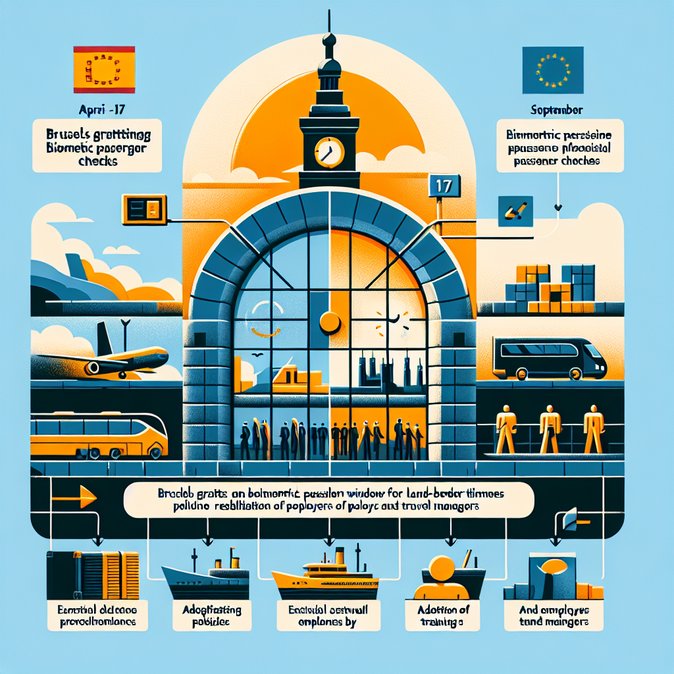
The European Commission confirmed on 2 March that Spain will be allowed to delay full enforcement of the new Schengen Entry/Exit System (EES) at its airports until September 2026, instead of the original 10 April deadline. The concession grants Aena-operated gateways – notably Barcelona-El Prat, Madrid-Barajas and Málaga–Costa del Sol – a crucial five-month grace period to avoid peak-season chaos while they finalise biometric gates and staff training. Industry trials conducted last autumn showed that registering the facial image and fingerprints of every third-country passenger could add 30-50 % to processing times unless extra e-gates and ‘help lanes’ were installed. Spanish tourism chiefs warned of two-hour passport queues that would jeopardise the country’s 250 billion-euro visitor economy. With the reprieve, airports can phase-in equipment after the busy July–August window and run live pilots on quieter traffic days. For global-mobility teams the message is nuanced: airlines will still collect advance passenger data from April, and land borders such as La Línea-Gibraltar plan to go live this spring. However, travellers transiting Spain’s airports will not need to complete biometric enrolment until September.
![EES rollout for Spanish airports postponed until September, easing summer-peak pressure]()
At this juncture it’s worth recalling that VisaHQ can help travellers and corporate mobility teams stay ahead of these shifting requirements. Via its dedicated Spain page (https://www.visahq.com/spain/), the service tracks EES and ETIAS updates in real time, offers streamlined application tools, and provides personalised alerts that reduce border-control surprises.
Employers scheduling short-term assignments can therefore maintain existing check-in buffers, though they should update travel policies to include EES and the linked ETIAS pre-authorisation, now pencilled in for early 2027. The Spanish Confederation of Hotels applauded the decision, saying it protects summer revenue and gives operators time to train front-desk staff on explaining the new rules to non-EU guests. Conversely, privacy advocates argue that the delay underscores technical fragility and urge Brussels to commission an independent audit before the system stores millions of biometric templates. In the coming weeks Aena will publish an updated implementation roadmap detailing gate layouts, transfer-passenger procedures and contingency lines for crew and elderly travellers. Corporations with high intra-EU mobility should monitor these circulars and test their duty-of-care alerts to ensure employees capture the new requirements once the grace period ends.

At this juncture it’s worth recalling that VisaHQ can help travellers and corporate mobility teams stay ahead of these shifting requirements. Via its dedicated Spain page (https://www.visahq.com/spain/), the service tracks EES and ETIAS updates in real time, offers streamlined application tools, and provides personalised alerts that reduce border-control surprises.
Employers scheduling short-term assignments can therefore maintain existing check-in buffers, though they should update travel policies to include EES and the linked ETIAS pre-authorisation, now pencilled in for early 2027. The Spanish Confederation of Hotels applauded the decision, saying it protects summer revenue and gives operators time to train front-desk staff on explaining the new rules to non-EU guests. Conversely, privacy advocates argue that the delay underscores technical fragility and urge Brussels to commission an independent audit before the system stores millions of biometric templates. In the coming weeks Aena will publish an updated implementation roadmap detailing gate layouts, transfer-passenger procedures and contingency lines for crew and elderly travellers. Corporations with high intra-EU mobility should monitor these circulars and test their duty-of-care alerts to ensure employees capture the new requirements once the grace period ends.