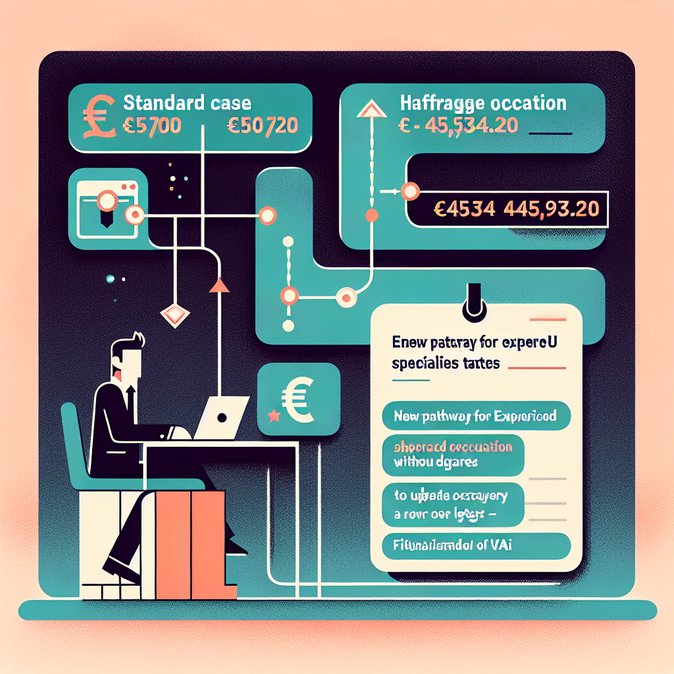
On 1 March 2026, specialist immigration portal Germany Unpacked published the first comprehensive guide to the 2026 version of the EU Blue Card, Germany’s flagship residence permit for highly-qualified third-country nationals. The article confirms that, in line with January 2026 social-security adjustments, the standard minimum salary threshold has risen to €50,700 gross per year (€4,225 per month). Professionals in officially designated shortage occupations—including STEM-fields, healthcare and selected logistics and education roles—benefit from a reduced threshold of €45,934.20.
![Germany updates EU Blue Card salary thresholds & rules for 2026]()
For applicants and employers who need practical, hands-on assistance with these new requirements, VisaHQ’s dedicated Germany page (https://www.visahq.com/germany/) provides real-time eligibility checks, document-preparation tools and access to experienced visa consultants who can shepherd EU Blue Card applications from start to finish—streamlining the process and reducing rejection risks.
Employers must still guarantee contracts of at least six months’ duration, and the Federal Employment Agency must approve any position that falls under the reduced salary bracket. One of the most talked-about changes is a special pathway for experienced IT specialists who lack a formal university degree. Provided candidates can document at least three years of recent, relevant experience and meet the reduced salary floor, they may now qualify for a Blue Card without academic credentials. This closes a long-criticised gap in German immigration law that made it difficult to recruit senior developers and cybersecurity experts trained “on the job.” The guide also reminds employers and mobility managers of fast-track permanent-residence provisions: Blue Card holders with basic German (A1) can apply for a Niederlassungserlaubnis after 27 months, or after only 21 months with intermediate German (B1). Family-reunification rules remain generous—spouses may work without restrictions and are exempt from pre-arrival language tests. Practical implications are immediate. Global mobility teams must update 2026 compensation matrices and ensure that existing Blue Card holders continue to meet new salary floors when negotiating renewals or internal transfers. Recruiting departments should audit job descriptions to verify that offers issued from today reflect the correct 2026 figures, averting rejection risk at visa stage. Finally, the new IT-specialist provision opens a powerful additional channel for companies struggling to fill digital-skills shortages, provided HR can document experience robustly and budget for the lower, but still substantial, salary bar. With the second phase of Germany’s re-engineered Skilled Immigration Act kicking in later this year—bringing full rollout of the digital “Work-and-Stay Agency” portal—today’s threshold update is a timely reminder that immigration compliance is now a moving target rather than a once-a-year exercise. Mobility leaders that embed real-time monitoring of regulatory and salary changes into their workforce-planning cycle will gain a strategic edge in Europe’s most competitive talent market.

For applicants and employers who need practical, hands-on assistance with these new requirements, VisaHQ’s dedicated Germany page (https://www.visahq.com/germany/) provides real-time eligibility checks, document-preparation tools and access to experienced visa consultants who can shepherd EU Blue Card applications from start to finish—streamlining the process and reducing rejection risks.
Employers must still guarantee contracts of at least six months’ duration, and the Federal Employment Agency must approve any position that falls under the reduced salary bracket. One of the most talked-about changes is a special pathway for experienced IT specialists who lack a formal university degree. Provided candidates can document at least three years of recent, relevant experience and meet the reduced salary floor, they may now qualify for a Blue Card without academic credentials. This closes a long-criticised gap in German immigration law that made it difficult to recruit senior developers and cybersecurity experts trained “on the job.” The guide also reminds employers and mobility managers of fast-track permanent-residence provisions: Blue Card holders with basic German (A1) can apply for a Niederlassungserlaubnis after 27 months, or after only 21 months with intermediate German (B1). Family-reunification rules remain generous—spouses may work without restrictions and are exempt from pre-arrival language tests. Practical implications are immediate. Global mobility teams must update 2026 compensation matrices and ensure that existing Blue Card holders continue to meet new salary floors when negotiating renewals or internal transfers. Recruiting departments should audit job descriptions to verify that offers issued from today reflect the correct 2026 figures, averting rejection risk at visa stage. Finally, the new IT-specialist provision opens a powerful additional channel for companies struggling to fill digital-skills shortages, provided HR can document experience robustly and budget for the lower, but still substantial, salary bar. With the second phase of Germany’s re-engineered Skilled Immigration Act kicking in later this year—bringing full rollout of the digital “Work-and-Stay Agency” portal—today’s threshold update is a timely reminder that immigration compliance is now a moving target rather than a once-a-year exercise. Mobility leaders that embed real-time monitoring of regulatory and salary changes into their workforce-planning cycle will gain a strategic edge in Europe’s most competitive talent market.