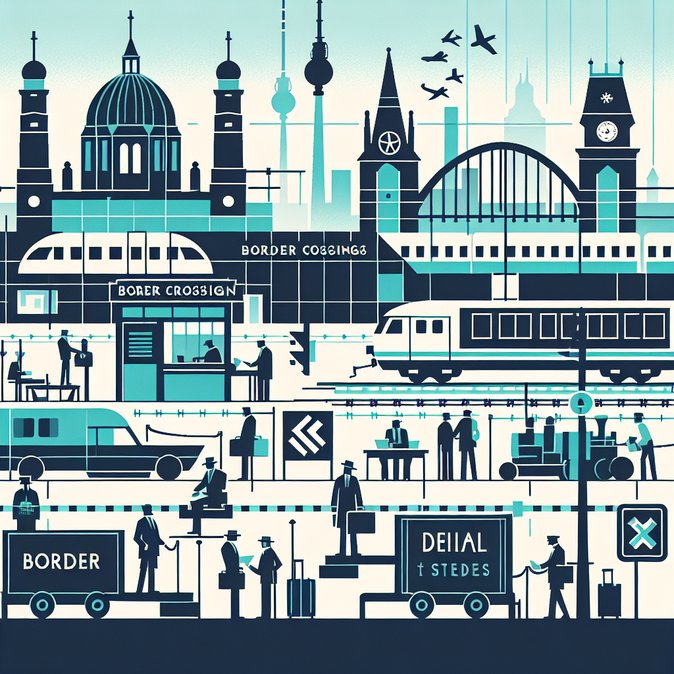
Germany has lengthened the temporary controls on its land border with the Czech Republic for another six-month period, pushing the expiry date out to 15 September 2026. Interior Minister Alexander Dobrindt told reporters that the measure is needed to “retain operational grip on irregular migration routes through Central Europe and to protect public security.” Spot checks on the busy D5 (Prague–Nuremberg) and D8 (Prague–Dresden) corridors, as well as on cross-border rail services, will therefore continue.
The decision, published late on 26 February, marks the fifth renewal since internal checks were re-introduced in September 2024. German police statistics show that more than 42,000 irregular entrants were detected at the Czech frontier in 2025; officials argue the controls have deterred people-smuggling and enabled 11,300 immediate refusals of entry. Prague has expressed concern about knock-on delays for just-in-time manufacturing supply chains, while freight associations warn that waiting times of up to 35 minutes per truck are now common at peak hours.
Legal scholars question whether an open-ended extension is compatible with the Schengen Borders Code, which frames internal checks as an exceptional, time-limited tool. The European Commission allowed COVID-era derogations to run far longer, but has recently signalled that migration-related controls should “remain strictly proportionate.” If Germany seeks another renewal in September, Brussels could demand tighter justification or even launch infringement proceedings.
![Germany extends border controls with Czech Republic until 15 September 2026]()
Amid these shifting requirements, travellers and mobility managers can turn to VisaHQ for real-time updates on Germany’s entry rules, Schengen day-count calculations and any visa documentation that may be needed for multi-country itineraries. The platform’s Germany page (https://www.visahq.com/germany/) consolidates official guidance and offers expedited processing services, helping businesses and individuals stay compliant as border policies continue to evolve.
For business travellers and corporate mobility teams, the immediate impact is practical rather than political. Passport or EU ID checks can occur on highways, inside trains and at regional airports handling Prague–Munich feeder flights. Although most inspections are cursory, companies moving high-value goods should build an extra 45 minutes into schedules and monitor real-time ‘green-lane’ updates issued by the Federal Police. HR departments are advised to brief assignees that Schengen day-count rules still apply: the border regime is a control measure, not a visa requirement.
Logistics operators continue to lobby for digital pre-clearance and dedicated freight lanes similar to those introduced on the Polish border. Whether the Interior Ministry will pilot such facilitation measures before September remains unclear, but industry groups say they are essential if Germany wants to balance security with the seamless movement of goods that underpins its export economy.
The decision, published late on 26 February, marks the fifth renewal since internal checks were re-introduced in September 2024. German police statistics show that more than 42,000 irregular entrants were detected at the Czech frontier in 2025; officials argue the controls have deterred people-smuggling and enabled 11,300 immediate refusals of entry. Prague has expressed concern about knock-on delays for just-in-time manufacturing supply chains, while freight associations warn that waiting times of up to 35 minutes per truck are now common at peak hours.
Legal scholars question whether an open-ended extension is compatible with the Schengen Borders Code, which frames internal checks as an exceptional, time-limited tool. The European Commission allowed COVID-era derogations to run far longer, but has recently signalled that migration-related controls should “remain strictly proportionate.” If Germany seeks another renewal in September, Brussels could demand tighter justification or even launch infringement proceedings.

Amid these shifting requirements, travellers and mobility managers can turn to VisaHQ for real-time updates on Germany’s entry rules, Schengen day-count calculations and any visa documentation that may be needed for multi-country itineraries. The platform’s Germany page (https://www.visahq.com/germany/) consolidates official guidance and offers expedited processing services, helping businesses and individuals stay compliant as border policies continue to evolve.
For business travellers and corporate mobility teams, the immediate impact is practical rather than political. Passport or EU ID checks can occur on highways, inside trains and at regional airports handling Prague–Munich feeder flights. Although most inspections are cursory, companies moving high-value goods should build an extra 45 minutes into schedules and monitor real-time ‘green-lane’ updates issued by the Federal Police. HR departments are advised to brief assignees that Schengen day-count rules still apply: the border regime is a control measure, not a visa requirement.
Logistics operators continue to lobby for digital pre-clearance and dedicated freight lanes similar to those introduced on the Polish border. Whether the Interior Ministry will pilot such facilitation measures before September remains unclear, but industry groups say they are essential if Germany wants to balance security with the seamless movement of goods that underpins its export economy.